
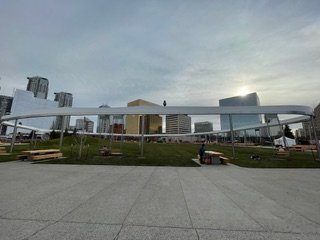
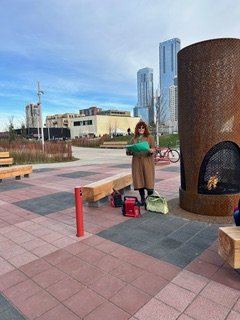
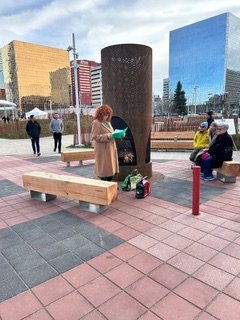
It was an honour to be asked to speak and read at the opening of Edmonton’s newest
urban park, on November 13, 2025. It’s a beautiful and inviting space right in the middle of the
downtown core. O-Day’min is Cree for “strawberry.” I decided to talk about what the
downtown meant to me, and how parks are a part of what I find essential in civilization.
I wore a new green dress which no one saw because it was under my early winter coat,
and my grandmother’s locket. When I was little she and I would walk in the park near her home
and she would crack the seed pods from the flowers and collect them in little offering
envelopes left over from Sundays she had missed going. When I questioned whether or not she
should be doing this, she said “Janice, this is a PUBLIC park. I am the PUBLIC.” And so we are.
To Celebrate O-Day’min Park
Edmonton’s New Downtown Urban Parkland
“Going Downtown” as a child with my mother meant dressing up properly. After all, we’d be going to the fancy stores she shopped at, like Mr. Donovan’s and Shillingtons, and Tall Girl and Holt Renfrew. I recall tripping flat on my face in that fancy department store once while
rebelliously wearing a ski jacket and jeans, and thinking they’d have likely judged me less if I’d been wearing a skirt and twinset. Of course, they’d have still thought me a klutz, I suppose.
When I was a bit older and allowed to take the bus all over town, I’d aim for downtown to have a bowl of borscht in the Ye Olde Java Shoppe before meeting friends for a matinee movie or whiling away an afternoon in the library. Sometimes we’d take our skates down to Winston Churchill Square to circle the huge lit up tree and spin around to the piped in music from CJCA. But there weren’t any park benches to just relax on, or people watch, or eat your lunch. All I recall were buildings. Cool buildings, like the concrete bamboo along the walls of the Tiki Tiki Restaurant, or the black-green marble of the Bank of Montreal. Funky restaurants like Ciros, or the Silk Hat, or the Seven Seas. The replica of the Venus De Milo in the foyer of Hurtig Books and their circular staircase. The smell of newspaper and cigars and wet wool in Mikes Newstand. People dressed up in Klondike outfits in banks and shops in July. Parades down 2 Jasper Avenue with marching bands and clowns handing out apples. Bathtub races. Christmas lights. Trolley buses. Downtown had a magic that drew me.
I got a part time job working for Classic Books when I was just out of junior high. There wasn’t all that much need for me out in Londonderry Mall, so I got sent downtown on Saturdays, to help out in the City Centre Mall, or the small McCauley Plaza shop, or the Classics Annex on Jasper Avenue. My idea of being able to read all day wasn’t quite what the job turned out to be. Mostly I dusted and took inventory, and occasionally got to use the till. But still, I was around books.
The year before university, I got a job in the Boardwalk, working at Cargo Canada, which I thought was the coolest place. My new university digs were kitted out in wicker and Indian cotton, purchased with my staff discount. And when the summer came, back I went downtown
to look for work. I found it, working in one of those fancy-ass stores my mom used to shop at, Holt Renfrew. The original store was situated right on Jasper Avenue, over by where the Wee Book Inn sits now. There were brass elevators that were polished every weekend, and thick
cream carpets, and wonderful, idiosyncratic people running each department, and a marvellousmanager, and amazing clothes and shoes and make up way too expensive for me to even think of buying. I went back every summer to work there and eventually managed to purchase a pair
of Bruno Magli shoes and a Diane von Furstenberg wrap dress. And every summer, when I went downtown to work, it felt as if the city had erectedthree or four new buildings and moved various things around. Boom times, I guess. But in all that time, no parkland showed up, except one small square of trees at the corner of Jasper and 102 Street. They even paved over Churchill Square around then. Why bother with greenspace, when you have the longest contiguous urban parkland in North America right down a fewblocks in the river valley, eh?
I worked for a decade at Grant MacEwan and walked past the empty buildings that would be repurposed as lofts and cut across the various parking lots that had been the Warehouse district, on my way to catch the LRT home. This was around the time that people joked about rolling the downtown sidewalks up at night. Eventually, things began to pick up again, but still no parkland, just some spindly trees here and there poking out of grates in the sidewalks.
When I became a public servant, I bounced around quite a few buildings from 100thstreet to 109th , and eventually ended up in the Queen Elizabeth II building over near the Legislature. Having the plaza with the fancy water spout fountains out front was great, but I cannot tell you how excited we were when Blue Cross turned part of their parking lot into a park, so we could grab a coffee and eat our lunch at tables out on greenspace.
And right around then I started writing a new mystery series. My first series had been about a young woman looking for work at the University of
Alberta and exploring all its nooks and crannies as well as Edmonton’s at the same time as helping to solve crime. As one does.
But I was at a new stage of my life and I could go places without having to worry about children or time clocks or figuring out who would shovel the walk in my absence. And so I went! As did my new character, a retired professor who explores great cities while reading literature set in those places, and incidentally helps solve crime. I can’t seem to help sticking a body into things.
Imogene, my amateur sleuth, settles in to a place for a month at a time, so she can do it justice. She buys passes to museums to visit them over again at her leisure, she shops in markets, and grocery stores, and fancy-ass stores (without tripping). But one thing she discovers in every great city she visits is their glorious urban parks. These parks of course didn’t start out as public parks, they were the green spots of the very wealthy and all behind walls but at some point in the last couple of hundred years they opened their iron gates to all the citizens of their respective cities.
Most of the time Imogene finds herself living in very small apartments up very steep staircases, so it is wonderful to have benches in parks where to have a sandwich and read a book in the spring sunshine. Parks make a useful place to meet up with someone you’re not sure you want climbing all those stairs up to your place. And parks are an amazing place to watch the citizens of the city you’re in, resting, meeting, exercising, finding some respite. They are also a nice place to rest up after you’ve been wandering about wondering where would be a good place to put a body, but maybe that’s just me. I hope that’s just me.
And now here we are, Edmonton, with a brand new urban park of our own, buil tentirely for everyone right from the start, where tired parking lots used to sit on their crumbling concrete floes. Isn’t it grand? To celebrate, I thought I’d read you some descriptions of those parks Imogene has found herself in in Paris, and Dublin and Florence and Prague. The first two cities are in the books Victor & Me in Paris, and Wexford Carole, which are both in print, andmavailable right over on that side of the park, in the beautiful Audreys Books. The Florence adventure will be out next fall, and the Prague mystery the year after that. So you’re getting a sneak peak of those.
But mostly, I want to share Imogene’s park visits to give you a sense of how we stack up as one of the great and interesting cities of the world. Like Imogene, everything I see will always be shaped by the lens that is Edmonton. And you know, that is not a bad thing at all.
Selections from the Imogene Durant Mysteries
The Luxembourg Gardens, from Victor & Me in Paris
Her thinking was that she could continue in a north-easterly direction and find her way into the Luxembourg Gardens, and wend her way through them back home. Sure enough, having wandered down a street filled with tantalizing toy shops, making her wish she was shopping for a grandchild, and passing a crowd of school children in uniform milling about, released from their studies, she crossed a small street and
entered the Gardens through huge gates. This was a corner of the park she hadn’t explored, and she saw a set off group of beehives, delighting her. She had read about these urban beekeepers.
Strolling through the gardens, noting people sitting on benches and metal chairs, children sailing rented boats in the pond, and lovers walking hand in hand, she wondered what the ratio of tourist to citizen she was witnessing. Parisians were devoted to an appreciation of their city, as she had noticed when walking in other parks aroundlunchtime, and seeing young professionals exercising and eating their boxed lunches inthe green spaces.
Maybe Marcel was right. You needed the time to sit a while in the various corners of the city to truly appreciate it. You couldn’t engage with Paris from a seat in a tour bus. What was she doing even thinking about Marcel and his arguments? For all she knew, he was a serial killer. She hoped tomorrow’s conversation with Toni would give her some answers and even some closure, a term she despised for its overuse.
Just then, she came upon a white marble statue of a strong looking woman, her arms crossed with a scroll of a letter in one hand. She had long hair, some of it hanging in two plaits reaching almost to her knees. Her gaze was serene, almost benevolent.Imogene went closer to read the plaque beneath her feet on the plinth.
It said “Sainte Geneviève, Patronne de Paris, 423 – 512.” Imogene blinked back spontaneous tears. Geneviève had been her mother’s name. It felt like a sign that she belonged to this city in some small way. These gardens were begun in 1612 for Marie de Medici, who had moved across the Seine after the assassination of her husband, Henri IV, and was homesick for the Boboli Gardens in her home in Florence. It covers 56.8 acres and has been open to the public since the 17 th century.
St. Stephen’s Green from Wexford Carole
She turned another corner, snapped a photo or two of the Molly Malone statue with the breasts shiny from all the sad, groping posers who had come before her, and then wandered up toward Stephen’s Green Shopping Centre. Her plan was to explore the mall, see what there was
to see, possibly buy a book (although, of course, she had one in her purse), and then go find a bench in St. Stephen’s Green and relax till it was time to go meet up with Maedbd. The mall had a few shops she recognized from North America, and some very idiosyncratic local-owned stores, as well. There were enough gift shops to accommodate the visitors from the hotels nearby, but this was a shopping centre catering to the urban Dubliner. A plaque by the Sinnott’s Bar said this had been the Dandelion Market in the 1970s, and that U2 had played early gigs here.
Imogene dithered over some pretty coasters for her daughter and ended up buying them, and a tea cozy with the same design of sheep on it for her friend Lydia, who was watering her plants for her. She read through several “Irish Blessings” on linen tea towels, the sort that decorated her favourite fish and chip shop back home. It seemed as if the Irish were famous for fulsome wishes for good weather, good fortune, and good futures. In her youth, a television variety show back home had featured the band the Irish Rovers, who had always ended their program with the slightly irreverent “May you be half an hour in heaven before the Devil knows you’re dead.” So perhaps the Irish did have a stranglehold on the blessing market.
Etymologically, the word blessing came from the French, which meant “to wound,” and Imogene supposed that a “blessing” somehow stemmed from Christ’s wounds given for mankind’s sins. She wondered if the Irish had any idea that their mainstay tourist fare had such a stabby ancestry. She decided to stick to sheep.
She spotted some Waterford crystal in one shop window and made a mental note to ask Sighle how easy it would be to get to Waterford from their place. She then wandered through TJ Maxx and purchased a couple of thin mock turtlenecks for under her Aran sweaters, though
the ultrasoft pink wool one she’d just bought seemed non-itchy. She picked up a bottle of water in the quickie mart shop, making a note to herself to
deposit the plastic bottle before meeting up with Maedbd, who seemed very ecologically concerned. Soon she was ensconced on a bench in St. Stephen’s Green, ostensibly reading her book but mostly watching the students and older people strolling through the park. She loved
to watch people use their cities.
She had promised to pick up food to eat on the train. Maedbd wasn’t the vegetarian, that was her sister, Orla. Still, all Sighle’s children and grandchildren seemed intent on saving the world in some way. Imogene decided to aim for something featuring chicken or turkey. No one seemed intent on saving turkeys, beyond the US president once a year. And they were delicious with cheese. She had seen turkey and havarti sandwiches on the board at the café where she’d had her breakfast, and she could get them on the way back to the train station. She decided to walk diagonally to the corner of St. Stephen’s Green that held the large gate one walked around instead of through; it would cut some time off her walk.
She waited patiently for the light, something not all the young people around her were doing, but she was still not secure in determining which direction the car with right of way would be coming from, so she remained sedately on the corner till the walk light appeared and
she crossed Merriam Way.
St Stephen’s Green, originally 60 acres of marshy common on the edge of Dublin, was enclosed with a wall in 1664 and became a park for wealthy tenants of new two storey houses surrounding it. In 1877, on the initiative of Sir A. E. Guinness (yes one of those Guinnesses), anAct of Parliament opened the park to the public.
The Boboli Gardens, Florence, from “My Heart Belongs to Dante” (coming 2026)
“Now, let me take you to my favourite corner of Florence.” They walked across the courtyard, Imogene inwardly delighted that she felt like an old
hand directing him past the various line ups. She led him to the grotto first, and made him lean in to see the statuary on the sides. “Those little putti swimming don’t look like they’re having all that much fun,” Daniel remarked.
“I know! It’s as if there may be a sea monster below, isn’t it?” The woman Imogene shared greetings with wasn’t at the gateway to the garden, but themyoung man taking her place was diligent and polite, checking Imogene’s pass against her driver’s licence, and noting the date and time on Daniel’s day pass before waving them through.
“This knot garden at the top of the entrance stairs is probably the most fussy part of the entire place, and it’s pretty relaxed as knot gardens go. When I first arrived, it was full of daffodils, and now look, the irises are having their day.”
They decided to walk up toward the Neptune fountain, a route Imogene had only taken in the other direction previously. There was always a new aspect to be seen when going the other way, even on streets that were familiar. This time, she was noticing the statuary along the sides of the stairs. They were all more elegant and adult, as opposed to the children playing along the plinths around the pond further down the garden where Imogene liked to sit and read.
The gardeners must have been mowing earlier because the fresh smell of new cut lawn
greeted them at the next level, where they could just begin to see the top of Neptune’s head.
An old man was sitting on a bench near the lip of the first terrace, and Imogene turned to see
what his view would be. The Duomo could be seen across the river above the roof of the Palace
in the foreground, and the sky was bright blue dotted with very few wispy clouds. It was a
perfect day. Impulsively, she reached for Daniel’s hand, and he squeezed hers in response.
They trudged happily up to the top tier of the garden, where water bubbled around the feet of Neptune who was aiming his trident menacingly.
Imogene could never understand why the most peaceful gardens always seemed to have such violent statuary about. Did it somehow enhance the quiet of the surroundings? Or was it merely that the sculptors found it more enticing to note the bunched muscles of bodies
in tumult rather than the lassitude of relaxation? How much did the patron get to dictate the subject, she wondered? She had vague memories of a movie version of a pope quarrelling with Michelangelo about the subject matter of the Sistene Chapel ceiling, but aside from that, it had never occurred to her to question the motivation behind the subject matter in patronage
painters.
She recalled the two paintings of the favourite dwarf, and the garden statue of him, which probably was commissioned by Cosimo di Medici. There really was no accounting for taste.
Daniel looked properly impressed with the Boboli Gardens, to Imogene’s relief. She led him south past the giant modern head statue and down through one of the leafy side paths toward the pond with the island of lemon and orange trees. They moved into the centre of the
path as they neared the star mosaic and Daniel had her stand in the middle of the star and pose for a picture.
Thankfully, although there were plenty of people enjoying the gardens, the vastness of greenery absorbed sounds well enough for people to feel secluded. She and Daniel walked leisurely around the pond’s perimeter, pointing out the turtles and fish swimming lazily, and
noting the regal crane perched on one of the gates to the island. “This is where I’ve been coming to be able to sit outdoors and read,” Imogene said,
pointing to the benches around the walk. “As Rilke said, it’s hard to find a tree in Florence, unless you aim for one of the gardens. It makes me appreciate my balcony at home all the more.”
“Your balcony is a haven,” agreed Daniel, who had spent many an evening there admiring the river valley and sunset while drinking something admirably alcoholic. “So many cultures go without a patch of greenery all their own, I’ve noticed. Public parks are the answer, and the idea of going to the park to sit, or walk or commune with nature and connect with neighbours is very civilized. You note it in novels set in European cities
especially. One goes to see and be seen, but also of course, to drink in the aroma of the lilacs and the beauty of the magnolias, and to celebrate the renewal of the seasons.” “I thought I was really going to miss my garden when I downsized to a condo,” agreed Daniel, “but I didn’t miss the yardwork. It turns out a couple of flower pots and some herbs are all I really need. But I agree, it’s great to walk under trees and feel the green space around one.
The Japanese call it ‘forest bathing’ and see it as an important element to psychological health.” “I wonder if the lack of green spaces for the common Florentine had anything to do with the murders. Maybe they’re not murders about tourism at all, but about constriction.” The Boboli Gardens were begun by Eleanor de Medici (wife of Cosimo) in 1550, enlarged to 111 acres in the 17 th century and eventually opened to the public in 1766. It has been the inspiration of many European courts, and the model for the Luxembourg Gardens.
The Franciscan Gardens, Prague from “Czech Mate” (coming 2027)
They shook hands again outside the restaurant, and while Imogene decided to walk back through New Prague to get to the Mucha Museum on the way home, Filip left her to catch a tram on the other side of the boulevard.
She browsed in a couple of dress shops on the way back toward Wenceslas Square, and decided to leave the Mucha Museum to visit with Marjorie, after peering through the windows.
The weather was lovely and warm, so she made her way back to the other side of Wenceslas Square and into the peaceful Franciscan gardens behind the busy commercial street. There were plenty of benches, and lots of birdsong, and at the far end of the gardens, a day
care provided the sound of children playing. She couldn’t think of a better place to rest and relax.
Her phone pinged and she pulled it out of her satchel. It was Marjorie texting to say she had just got through security at the Edmonton airport and would see her soon. Imogene smiled in delight. It would be so nice to have her daughter all to herself for a week. She decided to take a few pictures of the gardens, in particular the statue of the little nuns that reminded her of her favourite statue in Puerto Vallarta, Mexico. They were like sails with faces, their wimples and robes flowing in the movement of the bronze. All around the garden were tall buildings, including a church with a glorious wall of tall windows. In the centre was a tiny building that housed a thrift shop Imogene had popped into a few days earlier, mostly out of curiosity.
She took a look at the photos she had taken. Some of them looked pretty artistic, she thought. She might even take a stab at painting the composition of lilacs and the statue she had just taken.
The photos from the restaurant were a study in contrast, very urban with their glass and brick and duct work. She zoomed in a bit. Filip was there in the window, but set against the brightness outdoors, he was mostly in shadow. She sighed. She wished he hadn’t been so coy about having his picture taken. She was sure Mariel would have liked a picture of her cousin. In about twenty-four hours her daughter would arrive. Maybe on the way home, she would buy some tulips to go with the pussy willows on the table. Otherwise, everything was ready.
Founded in 1347 as the fruit and vegetable garden for the monastery, a chapel was built in the centre in the Baroque period and during the war, the Germans placed a large fire tank in the middle of things. In the 1950s, the Franciscans were “abolished” and the garden was opened up to the public. It is the only publicly accessible garden in the centre of the city, and is an oasis of calm with busy Wenceslas Square less than 100 metres away. Prague is a city of gardens, though, with 52% of the city lands devoted to greenspace.